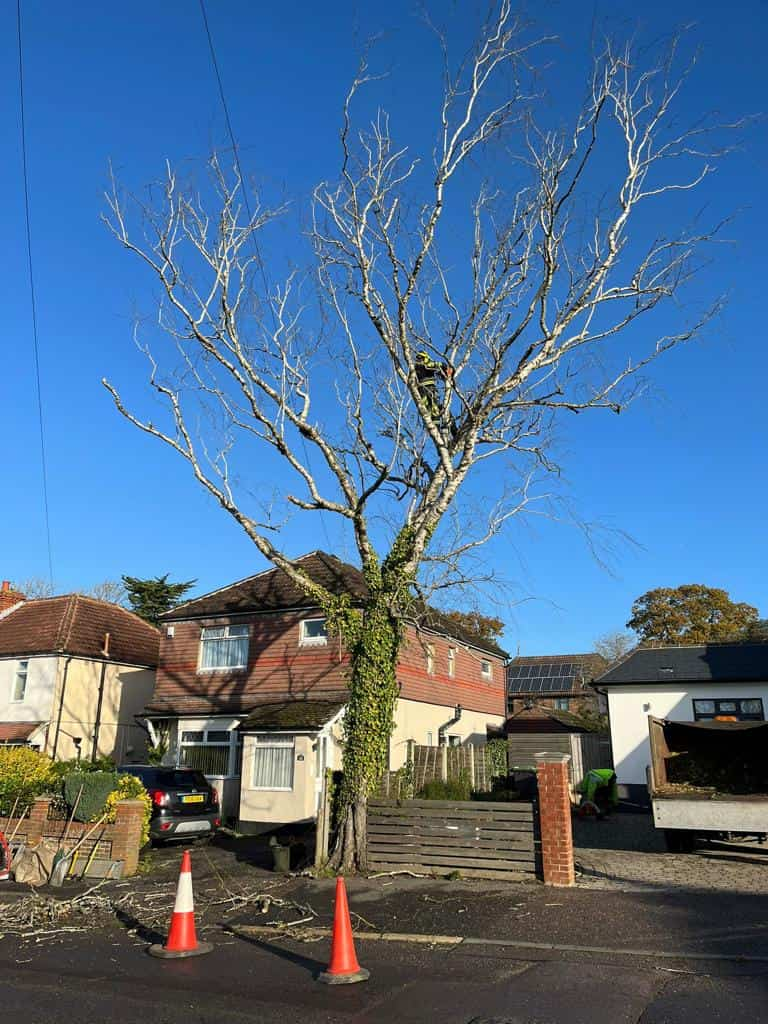
When a tree develops a problem, removing it is not necessarily the first or most appropriate solution. Many common issues can be managed through carefully planned tree surgery, particularly when the tree remains healthy and structurally suitable overall. Pruning, crown reduction, crown thinning, deadwood removal and other targeted work can often address specific concerns while allowing the tree to remain an established feature of the garden.
For property owners in Epping, Essex, the key is to understand exactly what is wrong before deciding what work is required. A tree that has become too large for its surroundings presents a very different situation from one that is dead or significantly unstable. Professional assessment can determine whether the problem can be resolved while retaining the tree and, where possible, identify the least extensive intervention needed.
What Tree Problems Can Often Be Managed Without Removing the Tree?
Tree felling is generally considered when retaining a tree is no longer appropriate because of its condition, structure or relationship with its surroundings. However, many everyday tree problems do not reach that point.
Excessive growth, individual dead branches, an unbalanced crown, low branches and dense foliage can frequently be managed through targeted tree surgery. The appropriate method depends on the tree and the specific problem rather than simply how large or inconvenient it appears.
A Tree That Has Become Too Large May Not Need Felling
Mature trees can eventually feel out of proportion with their surroundings.
Branches may extend further across the garden, the crown can become increasingly dominant and the tree may occupy considerably more space than it once did.
Size alone does not mean that removal is necessary.
Where the tree remains suitable for retention, carefully planned crown reduction may help manage its overall dimensions while preserving an appropriate natural form.
Crown Reduction Can Manage Excessive Growth
Crown reduction involves selectively shortening branches throughout the crown to reduce its overall height or spread.
The objective is not simply to cut the tree back as severely as possible.
A well-planned reduction considers the tree’s existing structure and retains an appropriate framework of branches. This can make a large tree more suitable for its surroundings without requiring complete removal.
The amount of reduction should always reflect what the individual tree can appropriately accommodate.
Overhanging Branches Can Often Be Managed Selectively
Branches extending over lawns, patios, paths or driveways can cause concern, particularly as a tree matures.
Their presence does not automatically mean that the complete tree needs to be felled.
Where the branches themselves are healthy, selective pruning may sometimes improve clearance or manage their extent. If individual branches are damaged or dead, work can be focused specifically on those sections.
The wider crown should be considered so that pruning does not unnecessarily unbalance the tree.
Low Branches Can Often Be Pruned
As trees grow, lower branches can begin interfering with normal use of the space beneath them.
They may extend across a path, reduce clearance within the garden or make access around the tree increasingly inconvenient.
Carefully selected branch removal or reduction can sometimes improve clearance while retaining the majority of the crown.
The work should be proportionate, particularly on mature trees where removing numerous substantial branches can significantly alter their structure.
Individual Dead Branches Do Not Usually Mean the Tree Is Dead
Deadwood is common within mature trees.
A tree can contain one or several dead branches while continuing to produce healthy growth throughout the remainder of its crown.
In these circumstances, selective deadwood removal may be appropriate.
This allows deteriorating branch material to be removed while preserving healthy living sections of the tree. Professional assessment can also confirm whether the deadwood is genuinely localised or forms part of wider decline.
Deadwood Removal Can Preserve an Otherwise Healthy Tree
Removing dead branches is very different from felling the complete tree.
Where the main trunk, root system and majority of the crown remain in suitable condition, deadwood removal can focus entirely on the affected branches.
This is particularly relevant where dead branches extend above frequently used garden areas.
The aim is to address the specific problem without removing healthy growth unnecessarily.
One Broken Branch Can Often Be Dealt With Locally
Branch failure can look dramatic, especially when a substantial limb breaks during windy conditions.
However, one failed branch does not automatically mean that the complete tree has become unsuitable.
The remaining branch union and surrounding crown should be assessed to understand why the failure occurred.
Where the damage is confined to one section and the wider tree remains structurally appropriate, selective pruning may be sufficient.
Storm-Damaged Trees Do Not Always Need Removing
Wind can damage individual branches without causing complete structural failure.
Following noticeable damage, the important question is how much of the tree has actually been affected.
Broken or hanging branches may need removal, while damaged branch ends can sometimes be pruned appropriately. The remaining crown, trunk and root area should also be considered.
If these remain suitable, retaining the tree may still be entirely practical.
Hanging Branches Can Be Removed Without Felling the Tree
A partially detached branch can sometimes remain caught within the crown.
Although the situation may appear serious, the defect can still be confined to that individual limb.
Professional tree surgeons can assess the affected section and the branch structure surrounding it.
Where the rest of the tree remains healthy and suitable, removal of the damaged branch may resolve the immediate problem without requiring more extensive work.
An Uneven Crown Can Often Be Improved
Trees do not always develop perfectly balanced crowns.
Competition for light, neighbouring vegetation, earlier pruning and available growing space can all influence how branches develop.
One side of the crown may eventually become considerably denser or more extended than another.
Where intervention is appropriate, selective pruning can sometimes improve the crown’s balance while retaining the tree’s established structure.
An Overextended Branch May Be Reduced
Individual branches can sometimes develop considerably further than the surrounding crown.
Where this creates an unsuitable growth pattern, selective reduction may be considered.
This involves shortening the relevant branch to an appropriate growth point rather than removing it automatically.
The condition and structure of the limb need to be considered before deciding whether reduction, removal or no intervention is the most suitable approach.
Dense Crowns Can Sometimes Be Managed Through Crown Thinning
Some trees develop particularly dense crowns containing numerous branches and considerable internal growth.
Where appropriate for the individual tree, crown thinning can selectively remove a proportion of smaller branches while retaining the overall dimensions and natural shape of the crown.
This is different from crown reduction.
The objective is not necessarily to make the tree smaller, but to selectively manage branch density where there is a genuine reason to do so.
Excessive Shade Does Not Automatically Require Tree Removal
A mature tree can cast substantial shade across a garden.
As the crown develops, this can change how parts of the outdoor space feel and how much daylight reaches particular areas.
Removing the entire tree is not necessarily the only option.
Depending on the tree’s structure and condition, appropriate crown management may help improve the relationship between the tree and its surroundings while retaining it as part of the garden.
Branches Blocking Useful Clearance Can Often Be Managed
Tree growth can gradually reduce clearance above paths, garden areas and driveways.
This is often a branch-management issue rather than a reason for felling.
Selective pruning can sometimes provide the required clearance without dramatically altering the rest of the crown.
Professional planning is important because repeatedly cutting branches back without considering their growth pattern can lead to an increasingly poor structure.
A Tree Close to a Garden Feature Does Not Automatically Need Removing
As both gardens and trees develop, established trees can sometimes appear increasingly close to other features.
Proximity alone does not determine whether a tree should be felled.
Its condition, dimensions, branch growth and actual interaction with the surrounding space all need to be considered.
In many cases, selective crown management may provide a more proportionate solution than removing an otherwise suitable tree.
A Leaning Tree Is Not Automatically Unstable
Some trees naturally grow at an angle.
If a lean has existed for many years without noticeable change, the tree may have developed its root system and crown in response to that position.
A newly developing or increasing lean is more significant and should be assessed professionally.
Where a longstanding lean is stable and there are no other significant structural concerns, felling should not automatically be assumed necessary simply because the trunk is not vertical.
Crown Imbalance Can Sometimes Be Managed
A tree with substantially more growth on one side can appear concerning, particularly where large branches extend in one direction.
The significance depends on the complete structure.
Where professional assessment identifies suitable opportunities for pruning, selective crown management may help address particular areas of excessive growth.
The aim should be to work with the tree’s existing structure rather than trying to force it into an artificial shape.
Previous Poor Pruning Does Not Always Mean the Tree Is Beyond Improvement
Trees that have been repeatedly or poorly cut can develop awkward regrowth.
Dense shoots, unbalanced sections and unnatural branch structures may appear over time.
Although previous work cannot simply be reversed, professional tree surgery can assess how the tree has responded and determine whether its future growth can be managed more appropriately.
Corrective work may need to be gradual rather than attempting to reshape the entire tree in one visit.
Regrowth After Previous Pruning Can Be Managed
Strong regrowth following earlier pruning is not unusual.
If repeatedly left unmanaged, new growth can eventually become dense and extend significantly beyond the desired crown.
Professional pruning can selectively manage this growth while considering how the tree is developing.
This can be particularly valuable where the objective is to retain the tree but prevent its crown from becoming increasingly unsuitable for the available space.
A Large Tree Can Often Be Retained Through Planned Management
Tree size is frequently one of the main reasons property owners begin considering removal.
However, a large tree that remains healthy and structurally suitable may have several management options.
Depending on the circumstances, crown reduction, selective pruning or deadwood removal may address the specific concerns.
Professional tree surgery is valuable because it focuses on what needs changing rather than assuming that the entire tree has become a problem.
Multiple Small Problems Do Not Necessarily Mean Felling
A tree may have several relatively minor issues at the same time.
There could be some deadwood, an overextended branch and areas of dense growth, for example.
The presence of several issues does not automatically make removal necessary.
Each problem should be assessed individually and then considered as part of the complete tree. Several targeted pruning operations can sometimes be combined into one carefully planned programme of work.
Selective Pruning Can Retain Healthy Growth
Good tree surgery does not involve removing branches without a clear reason.
Selective pruning focuses on specific growth that is dead, damaged, poorly positioned or unsuitable for the intended management objective.
Healthy branches that do not need intervention can remain untouched.
This targeted approach helps retain as much of the established crown as practical while addressing the problem that prompted the work.
Some Tree Problems Need Monitoring Rather Than Immediate Work
Professional assessment does not always result in a recommendation for pruning or removal.
A feature that appears concerning from the ground may prove to be a normal part of the tree’s established structure.
In some circumstances, observing whether the condition changes can be more appropriate than carrying out unnecessary work.
This is another reason assessment has value: it can identify when intervention is required and when leaving the tree alone is the better approach.
Felling Becomes More Relevant When the Whole Tree Is Affected
Although many problems can be managed without removal, there are circumstances where felling may become the appropriate option.
A completely dead tree cannot recover. Significant structural deterioration affecting the trunk or root system can also be fundamentally different from a defective individual branch.
The distinction is whether the problem can be addressed while retaining a suitable tree.
If the underlying issue affects the viability or structural condition of the complete tree, pruning alone may not provide an appropriate solution.
Root-Related Instability Cannot Be Solved Simply by Pruning Branches
Where a tree is actively moving at its base, developing a new lean or showing other signs of significant root-related instability, attention should focus on the complete tree.
Removing several branches does not automatically restore a compromised root system.
Professional assessment is particularly important in these circumstances.
It can determine whether the tree remains suitable for retention or whether the underlying problem makes a different approach necessary.
Extensive Trunk Deterioration Requires Broader Assessment
Problems within individual branches can often be managed locally.
Significant deterioration within the main trunk can have wider implications because the trunk supports the complete crown.
Cracks, substantial structural changes or extensive deterioration therefore need to be assessed differently from ordinary pruning requirements.
Felling should still not be assumed automatically, but the complete structure needs to be understood before deciding whether retention is appropriate.
Complete Tree Death Is Different From Localised Deadwood
This distinction is particularly important.
A healthy tree containing one dead branch can often be managed through deadwood removal. A completely dead tree cannot return to healthy growth and its structural condition will continue changing over time.
Confirming whether decline is localised or affects the complete tree helps determine whether preservation remains practical.
Professional tree assessment prevents isolated deadwood from being mistaken for complete tree failure.
Signs That a Tree Problem May Be Manageable Without Felling
Alternatives to felling may be possible where:
- deadwood is confined to individual branches;
- one branch has been damaged or broken;
- the crown has simply become too large for its surroundings;
- lower branches are reducing useful clearance;
- particular branches have become overextended;
- the crown has developed unevenly;
- dense growth requires selective management;
- previous pruning has resulted in unsuitable regrowth;
- a longstanding lean remains unchanged;
- the majority of the tree remains healthy and structurally suitable.
The appropriate tree surgery method will depend on the individual tree and the reason for intervention.
Why Avoiding Unnecessary Felling Can Be Beneficial
Established trees can make an important contribution to the character and usability of a garden.
Where a tree remains suitable for retention, targeted management can preserve that established feature while addressing the specific problem.
The objective should not be to retain every tree regardless of condition, nor to remove trees whenever they become inconvenient.
A balanced approach considers what can reasonably be improved through professional tree surgery and whether the tree remains suitable for its surroundings.
Choosing the Correct Tree Surgery Method Matters
Different tree problems require different solutions.
Deadwood removal addresses dead branches. Crown reduction manages overall crown dimensions. Crown thinning selectively manages branch density, while targeted pruning can improve clearance or deal with individual damaged and unsuitable branches.
Using the wrong method can result in unnecessary work without properly resolving the original concern.
Professional assessment helps match the tree surgery technique to the actual problem.
Why Professional Tree Assessment Matters
It can be difficult to judge from the ground whether a tree problem is localised or affects the complete structure.
A large branch may appear concerning but prove structurally suitable. A small visible defect may form part of a more significant issue elsewhere within the tree.
Professional assessment considers the crown, trunk, visible root area, growth pattern and surrounding space together.
This makes it possible to recommend proportionate tree surgery while retaining healthy growth wherever appropriate.
Professional Tree Surgery in Epping, Essex
At Epping Tree Surgeons, we believe tree work should reflect the actual condition and requirements of the individual tree.
Many common problems can be addressed without felling. Dead branches can often be removed selectively, oversized crowns may be managed through appropriate reduction, and individual damaged or overextended branches can frequently be dealt with through targeted pruning.
For property owners in Epping, Essex, professional assessment can establish whether a tree can be retained and which form of tree surgery provides the most appropriate solution.
Conclusion
Many tree problems can be solved without felling. Deadwood, damaged branches, excessive crown growth, low branches, dense foliage, uneven development and unsuitable regrowth can often be managed through carefully planned tree surgery while retaining the healthy structure of the tree.
The important distinction is between a localised problem and deterioration affecting the complete tree. A healthy tree with one defective branch is very different from a completely dead or significantly unstable tree.
Tree felling should therefore not be treated as the automatic response whenever a tree becomes large, inconvenient or develops a manageable defect. Professional assessment can identify whether pruning, crown reduction, crown thinning, deadwood removal or another targeted approach can resolve the problem while preserving the tree.
If you have a tree that has become difficult to manage or are unsure whether it genuinely needs removing, contact Epping Tree Surgeons. We can assess trees in Epping, Essex and recommend an appropriate tree surgery approach based on their actual condition and requirements.
Call us on: 01992932 996
Click here to find out more about Epping Tree Surgeons
Click here to complete our contact form and see how we can help with your tree care needs.